Latest Event Updates
“Prevention techniques for guitar players” Berlin 5 may at “The holygrail guitar show”

Playing instruments often causes significant strains on a musician’s body. To avoid physical problems, it is fundamental to keep good body control throughout the act of playing. This workshop aims to uncover the most important problems in the use of the guitar. The guitarist will learn simple exercises and strategies to treat possible overload and to improve the musical performance starting from a biomechanical approach.
Sorgente: LECTURE: MAURO BANFI “Prevention techniques for guitar players”
Bass and guitar players, preferences and problems
Here the most frequents problems of bass and guitar players, preferences of setup etc. Give your answers and share if you like!
The visceral system, friend and enemy of the singer.
Visceral system, postural system and movement of respiratory bellows are all interconnected and interdependent. Abdominal pressures, pulmonary air pressures are continuously balanced. This generates an airflow suitable to the emission, both spoken or sung.
 Different vocal techniques may use these structures differently and they can be applied more to costal mobility or more to that under diaphragm by seeking spaces more in side or anterior-posterior diameters.
The movement is also possible thanks to the adaptation of abdominal visceral structures, which have the power to provide or to limit the space, partially or appreciably, sometimes creating discomfort.
The most common problem, concerning the visceral system of the singer, is the gastroesophageal reflux and sometimes also the hiatal hernia, due to many causes.
The visceral system has a precise biomechanics influenced by costodiaphragmatic mobility, which is capable of altering the normal function, both at rest and during activity of the singer, in case of disease, dysfunctions and scars.
Voice in microgravity
In what way and how much the postural system influences the vocal emission is a mystery that has not yet been fully revealed. Nevertheless, it is interesting to evaluate – under conditions of zero gravity – how the characteristics of the singer can be different with respect to the same action, which is expressed on Planet Earth.
A singer in the space? Well, this is the Col Chris Hadfield who released a music video recorded of the famous “Space Oddity”, by David Bowie.

My doubts about the recording of the vocal track have been clarified by the staff, confirming that the take of the voice track was recorded on the Station,
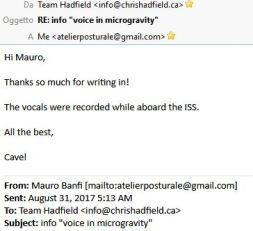 therefore under conditions of zero gravity and without the commitment of the muscular system with postural antigravity purposes.
Link to the video of “Space Oddity”
Most interestingly, he sings and publishes songs, available on his website http://chrishadfield.ca/music/
It is now up to yourselves to evaluate vocal characteristics under conditions of zero gravity with respect to those on Planet Earth.
Do the characteristics change? Yes, in my view, yes. We need to work on how to objectively assess them.
The postural system, under normal conditions on Earth, acts as structural support and as synergistic element for the vocal emission. Under conditions of zero gravity the support function fails and the postural scheme that is typical of the astronauts prevails, in hip and knee flexion, as can be seen in the video and in the photos. This may cause the modification of vocal characteristics in song.
We move more on the boundaries of knowledge. If the song “feeds on support”, we feed on our curiosity.
Singing and frequent postural problems
What is your frequent problem related to the singing practice?
Vote and share if you like. The results at the bottom of the poll, link “view results”
Thanks and good vibrations!
Vocal methods and body dysfuncion
I frequently read, especially in the web, about the “right method”, the “universal vocal technique”, the “new one” that overcomes to old and no more useful way to sing.
The respiratory dynamics becomes cause of clash between different teachers and coaches, searching for the perfect movement, the absoute control of the body micro mobility. Methaphors ride, comparing muscles to rubber bands, the singers is described like an athlete, the diaphragm (poor diaphragm) to anything that makes it easy to be described.
In my daily work, as osteopath treating singers and musicians, what I often see is the abuse of some hiper thecnicality in the vocal practice, that sometime becomes stressing at a postural and dynamic level. The cause?
Perhaps the lack of student comprehension, but also the low sensitivity (or specific preparation) of the teacher in observing the potentials or limits of the student.
We cannot apply the same methodology with the same results to all our students.
I observe and keep note of the most frequent problems of many of my patients, singers with postural disfunctions, in relation to the practice of singing;
I hope it will be useful to your didactic. The most common problems encountered:
- asymmetries of ribs movements
- difficulties in managing the ribs and abdominal movements
- excessive tension of the trunk and head postural muscles
- excessive muscular tension on the shoulders elevators.
These, among many others, are frequent problems in students who require my osteopathic cure. Sometimes problems also affect experienced professionals.
Is possible to solve these, restoring a physiological control of muscular activity. However, my invitation is mainly addressed to teachers. Methods should not be stictly standardized but adapted to the specificity of each student body. This principle is correct also for musicians, playing instruments. Improving coastal biomechanic, the coordination of the diaphragmatic bellow, normalizing the postural tension, is the goal of manual and re-education approach, always in collaboration with other specialists.
The management of forces, positions, is an important task for the teacher. He must be always clear in the speech and showing exercises for a correct student’s daily improvement.
Understanding the presence of problems listed above and not treating them, means an immediate loss of performance, and may bring to most serious dysfunctions or pathologies.
And you, teacher, coach or professional of the voice? What are the most frequent problems in you experience? Write them here if you want.
11th International course on phoniatrics and speech therapy
I’m very glad to participate as speaker in this course. I’m looking forward to learn from important specialists of the voice.
See you soon in Ravenna Italy 26-27-28-29 october

Singers and scars
Sometimes the singer must undergo surgery, although not strictly related to chordal dysfunction.
The more related with the vocal function is the vocal tract. This region can be influenced in its physiological dynamics and it’s important to assess its mobility post intervention.
The most common scar we can found is the frontal access for thyroidectomy. It appears as an horizontal line, visible just above the sternum, large up to 10 – 15 cm.
Sometimes the access to the thyroid provides scars U shaped that reach the lateral parts of the larynx. In this case the surgery is more invasive.
A frequent consequence of a scar is the retraction. Between the superficial and deep tissutal planes we can observe a loss of mobility, expecially in the sliding parameters, sometimes associated with swelling and fibrosis of the scar’s tissues that do not allow a correct biomechanic.
For the singer the mobility that can be limited is the upwards and downwards movement of the laryngeal tract. Sometimes we can also observe a lateral deplacement to the scar tissue. Often the head is tilted to the side of the retraction or the movements of rotation of the head can be limited in their range of motion. Even the opening and closing of the mouth can lead to a mandibule deviation.

Scars in the neck area can bring to uncorrect positions and a non phisiologic compensation in the phonation. Even scars situated in further anatomic regions can perturb the singing. Scars of the abdominal wall (classical appendectomy, or caesarean sections) can change the dynamic of the abdomen during inspiration and can influence, through deep fascial tensions the phase of appoggio and sostegno.
Where a scar is retracted the effect can lead to postural compensation even without sympthomps. It is essential, during the evaluation of the subject, to keep in mind this possibility.
If a student should have to undergo surgery it is useful to verify, in the post intervention period, if the scar tissue has postural influence in order to prevent the onset of symptoms which will lead in the long term. In this case manual therapy can be a good solution to the problem.
- ← Previous
- 1
- 2
- 3
- Next →
 Mauro Banfi Osteopathy for performers